
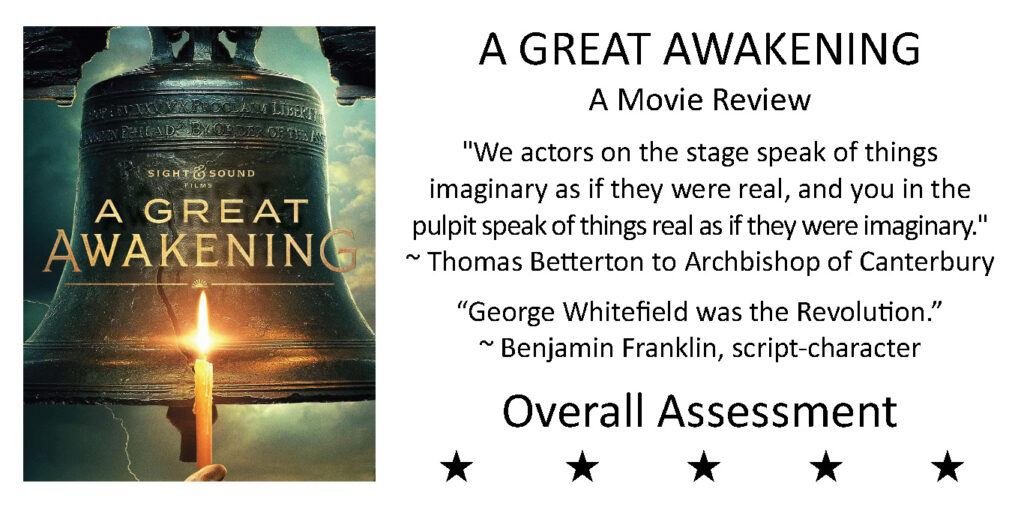
I waited with anticipation for the Easter release of A Great Awakening. I invited friends to join us. It was everything I hoped it would be. And surprisingly, and oddly, it was even more than I hoped it would be.
A GREAT AWAKENING is a 2026 historical drama directed by Joshua Enck that powerfully dramatizes the true story of the unlikely friendship between the evangelist George Whitefield and the secular Founding Father, Benjamin Franklin.
I am unqualified to critique the movie’s acting or directing or those other things about which a movie critic might comment. So, I will simply say that the acting, directing, cinematography etc. were on par with the best movies hitting theaters today. The script and its storytelling were, frankly, amazing for a biopic shackled to following genuine history.
If you’re looking for a concise review, I suggest Rotten Tomatoes. If you really want to geek out on the movie you might check out Rhetta Leon’s 133-page published review available on Amazon in paperback or Kindle. Or perhaps to simply dig a little deeper, check out the PDF Study Guide available on the movie’s website. And yes, I was geek enough to check out all of those.
It is important for us to remember that our nation was born at the crossroads of the peak of human reason replacing God and a peak of God simultaneously moving sovereignly in Britain and North America. Deism, then and now, is a philosophy that believes that God exists as an impersonal being that created the universe but does not and has not intervened in or interacted in the affairs of humanity. For the deist, there is a god but not the God that Christians or other human religions proclaim.
The movie’s plot is set in the Constitutional Convention while it was in gridlocked debate, and it appeared that the American Experiment would fail. The story is told as Franklin’s reflections between gridlocked adjournments, first remembering that it was the Great Awakening’s spiritual transformation in America that ignited the American Revolution, and then arriving beyond his deism to acknowledge the Source of both the awakening and the nation’s liberty.
“I have lived, Sir”, Franklin said, “a long time and the longer I live, the more convincing proofs I see of this truth – that God governs in the affairs of men.” That is possibly the most not-deist statement anyone, especially a deist, could make.
You can read Franklin’s entire address here: American Rhetoric.
In Franklin’s reflections between the congress sessions, the movie excellently develops the characters of both Franklin and Whitefield, pulling from history to spice the movie with genuine quotes from each. My excited anticipation for the movie was to see the interaction and dialog between the fiery Christian Whitefield and Ben Franklin a deist and exemplar of the Enlightenment’s view of human reason and virtue. The stage is set for a quite personal debate between Franklin and Whitefield that begins at 1:30 into the movie. The movie overtly presses the case for grace-based, faith-based, Christ-following life while both the deist-secular and Christian views are represented fairly and surprisingly well — in both positive and negative light.
When I left the theater after watching the movie (the first time) I realized that I had not been prepared to observe the foremost purpose in how the movie told this story. That realization prompted me to watch it again and explore it deeper—with interest, applause, and also with concern. My concern, which is the primary energy for writing this movie review, is the underlying theme presenting and supporting Christian Nationalism.
Christian Nationalism is an ideology that espouses a form of religious nationalism that focuses on promoting the Christian views of its followers in order to achieve prominence or dominance in political, cultural, and social life.
On the one hand, I absolutely believe Christians should prominently publicly evidence and witness about the way of life taught by Jesus the Messiah. I think the best recent description of this life is perhaps Dallas Willard’s two books, The Divine Conspiracy and The Divine Conspiracy Continued. I am convinced that any fair study of the birth of the United States would find the impetus was extremely toward founding a Christian nation. If you are unconvinced, I can loan to you an exhausting volume of DVD’s by David Barton of WallBuilders.
For more on Dallas Willard see my article Paper Mentor: Biographies and Dallas Willard’s Influence Upon Me and/or Book Reviews: The Theology of Dallas Willard: A Book Review, Eternal Living: A Book Review, and Becoming Dallas Willard: A Book Review. And Dallas Willard Ministries.
On the other hand, we have witnessed the political takeover of Evangelicalism in the 1980s and how that takeover has pulled much of the American church into a mentality of entitlement of religious rights, and exclusively Christian religious rights. I have watched — and even errantly participated in — the dialog that fighting for those rights will somehow sustain our Christian witness in the Western world. We have watched as Christians overtly support leaders of demonstrably un-Christian character because it is more important to win with the lesser of two evils than to lose the entitlement battle.
It is said that elections are so often the picking of the lesser of two evils. And, that unless Jesus Christ himself is on the ballot, any election will always be selecting the lesser of two evils. I agree. What I could not agree with is taking the battle for morality, Christian morality, to the public sphere rather than to the hearts of the individuals. Socio-political change cannot be forced. Morality cannot be legislated and be effective. Only the transformed heart will perceive character beyond virtue and live the moral life taught by Jesus the Messiah.
As energizing as Metaxas is in his Letter to the American Church, it ignores the true cause of why we are losing the battle in society as a whole and have moved America, since the 1960’s, from Christian to Post-Christian to Un-Christian. Perhaps we should consider Kinnaman’s & Lyon’s UnChristian: What a New Generation Really Thinks About Christianity. Perhaps we should more carefully consider James Davison Hunter’s cultural analysis and a “faithful presence” critiqued by Metaxas as an insufficient call to political action.
For the Christian sociologist James Davison Hunter, see To Change the World (2010), Democracy and Solidarity (2024), and Culture Wars (1992).
A GREAT AWAKENING is an amazing movie. It makes a balanced presentation of secular-deistic and Christian worldviews. It claims to be based on true events, and it lives up to that claim by sticking much closer to history than most other historical biopics. It is acted well, directed well, and is quite entertaining. I highly recommend A GREAT AWAKENING to everyone who could possibly be reading this review with any interest. …watch it at least twice.
The movie can now be streamed through several sources such as Amazon: A GREAT AWAKENING
__________________________________________________________________
Tim Morris is the Steward of Ecclesiolae, Inc. a ministries foundation, cofounded with Julie Morris, and Mel Miller. Ecclesiolae seeks to support Christians in their Spiritual Formation, Strengthening Ministry Marriages, and expanding the growth of MicroChurches within MegaChurches. Tim earned a BS in Business Management and an MA in Theology, from Wesley Biblical Seminary.
© Copyright –– Timothy D. Morris, Ecclesiolae, Inc. –– 2024 –– All Rights Reserved
All files and information contained in this Website or Blog are copyright by Timothy D. Morris and Ecclesiolae, Inc. and may not be duplicated, copied, modified, or adapted, in any way without our written permission. Our Website or Blog may contain our service marks or trademarks as well as those of our affiliates or other companies, in the form of words, graphics, and logos. Your use of our Website, Blog or Services does not constitute any right or license for you to use our service marks or trademarks, without the prior written permission of Timothy D. Morris or Ecclesiolae, Inc. Our Content, as found within our Website, Blog and Services, is protected under United States and foreign copyrights. The copying, redistribution, use or publication by you of any such Content is strictly prohibited. Your use of our Website and Services does not grant you any ownership rights to our Content.